

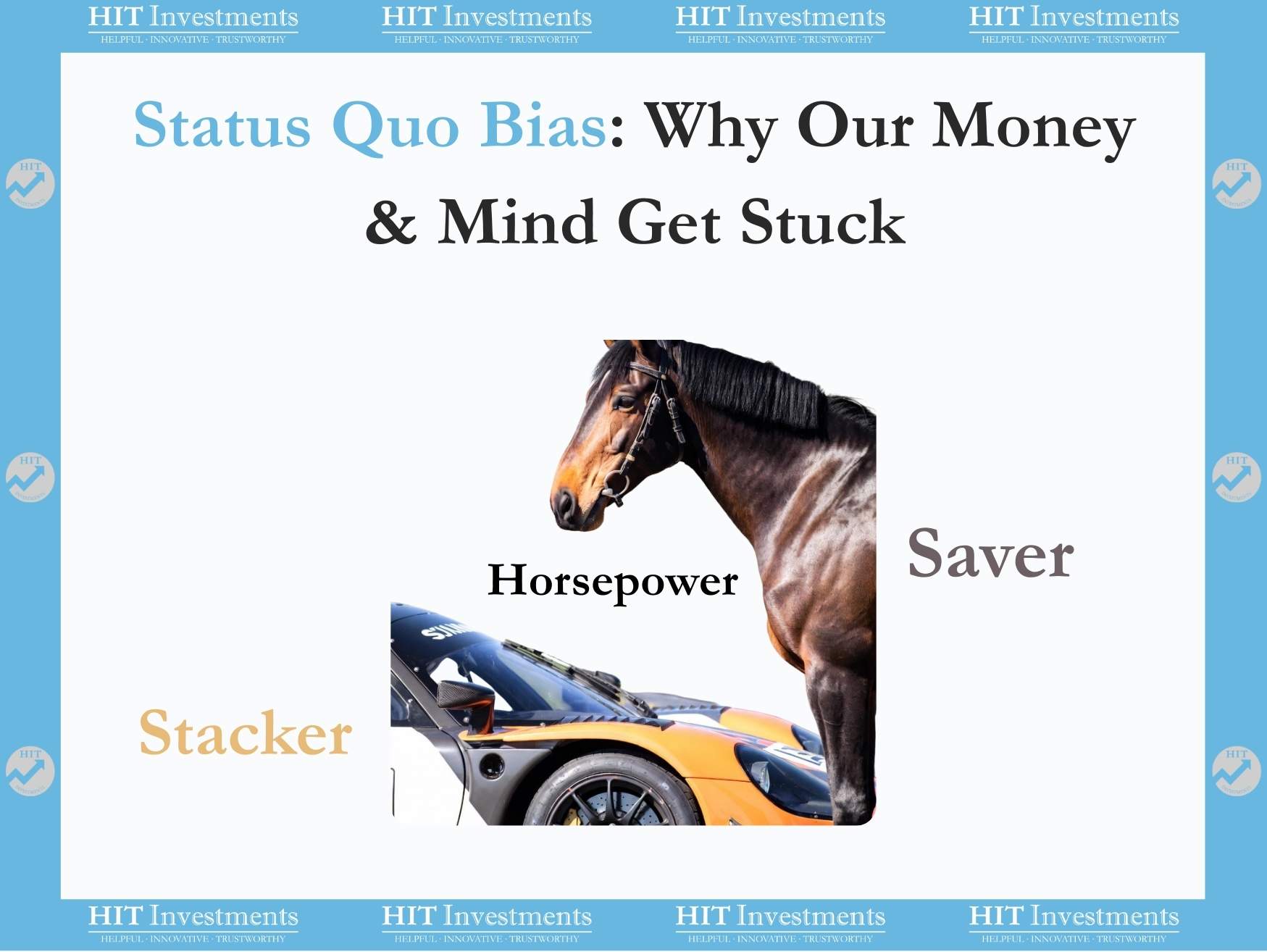
Status Quo Bias is our tendency to prefer things to stay the way they are, treating the current state as a sacred reference point from which deviation feels like a catastrophic loss, regardless of whether the current state is actually working.
It is the cognitive equivalent of me wearing the same pants year after year even though one pant leg is ripped, the legs are too short, and the elastic band is now non-existent. 
Like it or Not We Get Stuck in Our Ways
While we can laugh about my old pants, I cry when I see the damage it does to our finances. As Stacker’s we have goals and a purpose, and status quo bias continuously works to hold us back.
Consider my Discover savings account that I had opened back in college. The interest rate had been slowly deteriorating year after year and I knew it. But still, switching the bank account felt like a nuisance, and convincing my wife who does our day to day finances was going to be even harder. So for years, we didn’t change.
Loss Aversion Amplifies the Delusion
When our Status quo bias is really rolling it teams up with loss aversion, where losses feel roughly twice as painful as an equivalent gain. Opening a new cash management account meant 30 minutes of “hassle” (a loss). Earning some extra $ meant nothing to my emotional brain, or my wife, because the future money was abstract, but the 30 minutes of hassle was real.
It wasn’t until I did what I do for other stackers, and that is calculate the exact amount of money that we were going to lose. It was $871 a year! Well I didn’t want to lose $871 every single year, and neither did my wife, so we changed.
Two More Examples
The Credit Card Crap Trap: The majority of our members have had the same credit card for a decade. It earns points, miles, or may just look cool. I’ll share multiple 2% cash back card options, but not everyone switches. Why? They tell me:
- “I know this card well,”
- “I like the rewards,”
- “closing might hurt my credit score”
- “I like to use the airport lounge”.
The inertia to move is difficult. They are happy paying an annual fee and losing 2% to avoid thinking about the potential losses.
Today I shared with a member that he is losing $633 a year using his debit card. He made the switch and signed up right there on the spot.
The Forgotten Retirement Account: The majority of us are not still working for our first employer. But when I do my investment reviews I still see money sitting in previous employer’s 401k, 403b, or RRSP. When that happens we pay an extra admin fee and sometimes inflated fund expenses, up to 30x more than elsewhere.
I can see the pain in my members eyes when I recommend making a change. Transferring the old account feels like a project. I’ve heard:
- “Where do I find my password?”
- “Who would I even call?”
- “Where would I start?”
In a recent review, the fee difference I found was costing her 30x, or $113,226. Status quo bias was literally going to cost her more than a Model X, of which she regularly jokes about wanting to purchase.
How do Stacker’s Break Free From Status Quo Bias
I’ve found the counter to status quo bias isn’t willpower, it’s reframing.
- We Have Alternatives – Treat the status quo as one option among many, not as the default winner. If I was starting fresh today, what would I choose? If the answer is “something different,” our status quo is already losing.
- What is the Cost – Quantify the cost of inaction. This is the most important thing for me. I’m a numbers guy so instead of me thinking “maybe I’ll save a little money,” I just calculate it: “My savings account is costing me $871 per year compared to this cash management account. Make the abstract obvious.
- It’s a Loss, Not a Win – Reframe the cost of inaction as a loss. Use our aversion to loss as a positive force. It’s not a hassle to prevent someone from stealing what’s yours. Does that bank deserve to keep your cash? Hell No it doesn’t!
Beating Status Quo Bias Takes Vulnerability
In all three examples of beating status quo bias, none of us were happy when we did it. Yet all of us are better off for having made the change. Sarah and I have already made more than $2,000, Jake is making $633 more a year, and Jackie is getting her Model X (per say).
But it took step 3, reframing it as a loss, to get us all across the finish line. Only now, multiple years later, am I happy thinking about it. When Sarah and I made the change I was pissed and embarrassed, and I can see that is exactly how other stackers feel at the point of discovery too.
The Stacker Bottom Line
Status quo bias is not a quirk, it is a silent drain on our goals, and it keeps compounding until someone calls it out. Now that you know how it works, treating “how things are” as harmless is no longer an option.
It is always easier to see the holes in someone else’s financial pants than in our own. So if you hear me say, “I’ve always done…,” or notice me sticking with an obviously worse option, stop me and call it what it is: a costly status quo.
If you want the same accountability, invite it. Reply, comment, or send me a note with where you suspect you are “stuck,” and I’ll run the numbers with you to find the real cost of staying put. Together we will turn “this is how I’ve always done it” into “this is the best option for me now.”
Leave A Comment