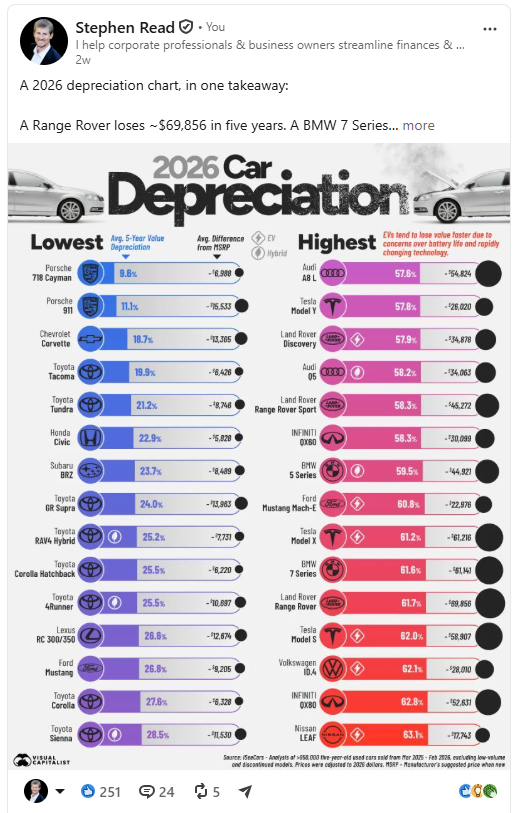
A few weeks ago, I shared a simple depreciation chart on LinkedIn. It struck a nerve: 251 reactions, 24 comments, and a lot of debate on EVs, Toyotas, and whether anyone should ever buy new.
A Range Rover loses about $69,856 in five years. A BMW 7 Series about $61,141. A Tesla Model S about $58,907. The first owner pays that bill. The Stacker buys the same car without it.
This post goes one layer deeper: why the decision to purchase a car matters, what it looked like when we did it ourselves, and the bias that makes the logical choice feel wrong.
Spend Your Time Where the Dollars Are Material
Buying a home or car is often one of the largest and most consequential financial decisions we make. In 2024, the average U.S. household spent $26,266 on housing (33.4% of spending) and $13,318 on transportation (17.0%), according to the Bureau of Labor Statistics. Together, that is about half of every dollar spent.
When it was time to replace our family car, the Tesla Model X checked every box. Room for our three kids. Enought headroom and sufficiently high headrests for my 6’7″ frame. Self-driving. And the kids got their own bucket seats and a screen in the back.
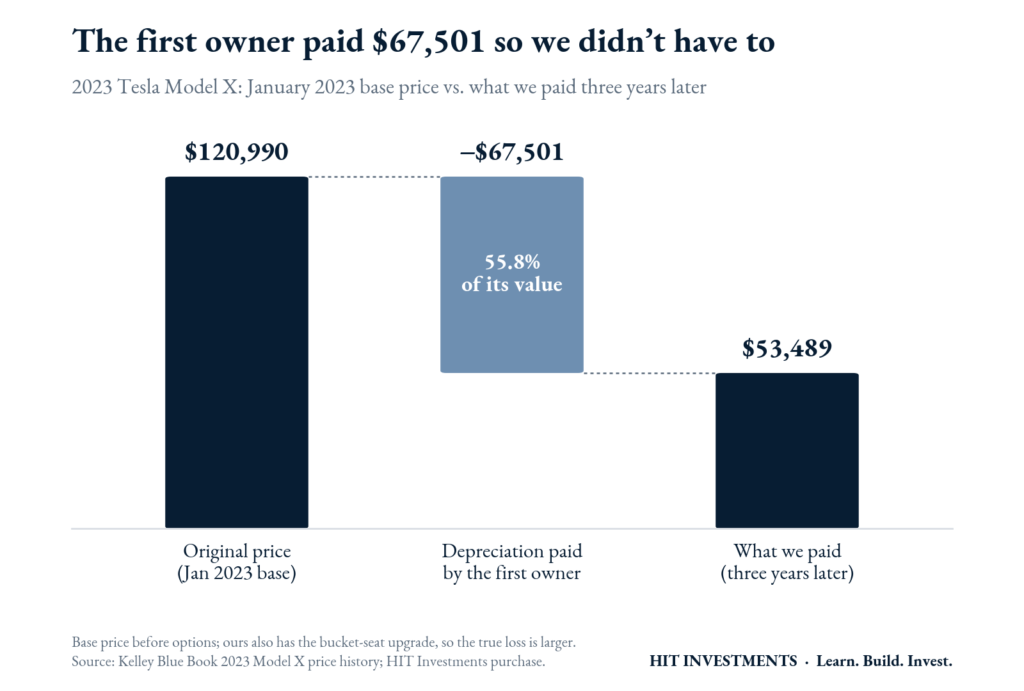
We did not buy it new. In January 2023, a new Model X started at $120,990, before adding the premium bucket-seat option ours came with. Three years later, we bought that 2023 Model X for $53,489. It had lost more than 55% of its value, and none of that loss was ours.
Same seats. Same hardware. Same over-the-air software updates. The first owner paid for the new car smell and the first three years of depreciation.
It came with trade-offs, though. The three-year-old Model X had about a year left on Tesla’s 4-year, 50,000-mile basic warranty. The 8-year, 150,000-mile battery and drive unit warranty still had several years remaining, and it was transferable. With $67,501 in savings, I thought it was an easy trade-off.
The Math Behind $67,501
iSeeCars analyzed over 950,000 five-year-old used cars sold from March 2025 to February 2026. The average car lost 41.8% of its value in five years. Luxury models lost the most.
Our Model X lost about 56% of its value in three years. iSeeCars puts the five-year Model X loss at 61.2%. Most of that loss showed up in the first three years, and the first owner absorbed it: at least $67,501, more than we paid for the car.
As an illustration, $67,501 invested at a hypothetical 7% annual return grows to about $132,785 in 10 years. That is what I consider the real price of the new car smell: the bill plus the opportunity cost.
One fair point raised in the LinkedIn comments was that recent Tesla depreciation reflects price cuts after pandemic-era highs. Pricing risk, technology risk, and model-refresh risk all land on the first owner.
Behavioral Bias Hiccup: Ambiguity Bias
If the math is this clear, why do so many smart people still buy new? One reason is ambiguity bias: our natural inclination to prefer the familiar option over the unknown, even when the unknown offers equal or better outcomes.
A new car feels certain. Zero miles, no history, nobody else’s habits. A used car carries questions. How was it driven? What about the battery? What am I not seeing? Those questions feel expensive, so we pay a premium to make them go away.
I felt that pull too. The fix is not ignoring the questions. It is answering them. Once the unknowns become knowns, the premium for certainty is what it is: tens of thousands of dollars for a feeling.
How a Stacker Buys a Car
Start with materiality. Give the car decision the research hours it deserves. Buying a car means writing one of the largest checks of our lives.
Let the steep part of the curve pass. Luxury and EV models often shed the most value early. A two- to four-year-old car can capture much of that discount.
Turn unknowns into knowns. Pull the vehicle history report, get an independent inspection, and, for an EV, check the battery health.
Compare the total cost, not the payment. Purchase price, financing, insurance, maintenance, and expected resale value all belong in the decision.
Invest the difference. The savings only compound if they land in an investment, not in the next upgrade.
Stack the Difference
The new car smell fades in a few months. The difference, invested, keeps working for decades. That is the Stacker trade: stack knowledge, stack capital, stack time.